Bagging & Boosting: Interview Roadmap
Both bagging and boosting combine models, but they organize the work differently. This series explains their central calculations and gives small examples you can reproduce. If trees themselves are new, start with one tree’s questions and predictions.
Two ways to combine trees
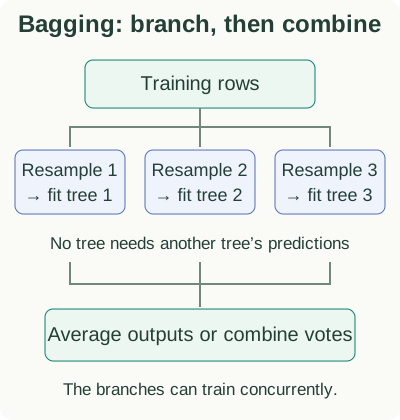
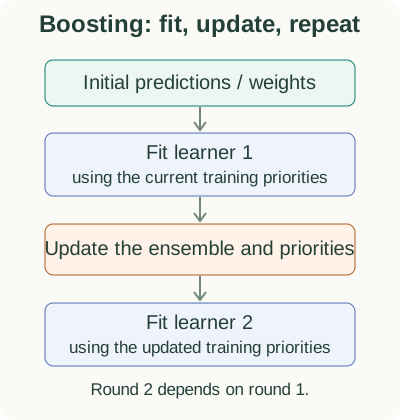
In gradient boosting, the changing priorities are correction targets computed from the current predictions. In AdaBoost, they are example weights based on earlier learners’ errors. Both create a dependency between rounds. Parallel split search inside one round remains possible.
| Question | Bagging / random forest | Boosting |
|---|---|---|
| How is another tree trained? | Use a different resample; forests also vary candidate features. | Use the current ensemble to determine the next correction. |
| How are outputs combined? | Average predictions or use a specified voting rule. | Add corrections; AdaBoost adds weighted votes. |
| What can run in parallel? | Separate trees can train without waiting for each other. | Rounds depend on previous rounds; work inside a round can parallelize. |
For a concrete prediction, three regression trees outputting 4, 7 and 7 yield a bagged average of 6. A gradient-boosted model starting at 6 with a next-tree correction of −3 and learning rate 0.5 instead moves to $6+0.5(-3)=4.5$. These chosen outputs illustrate the combination rules; they are not fitted results from the same dataset. The next regression example shows where a correction actually comes from.
Why combining predictions can help
A model can be wrong in a consistent way, or its predictions can change substantially when the training sample changes. These are the ideas behind bias and variance. Averaging diverse trees can reduce the second problem; adding useful corrections can improve the first.
“Bagging reduces variance; boosting reduces bias” is a starting intuition, not a strict division. Either method can change both, and neither guarantees better test performance. The variance chapter quantifies what averaging can and cannot remove.
Two separate paths, one connected curriculum
Follow the paths below in order if you are learning ensembles for the first time. They share the same story: first ask what averaging can fix, then ask what a new correction can fix. Each chapter ends with the question that motivates the next.
- Bagging: five chapters
Foundations → bootstrap aggregation → random forests → OOB evaluation and interpretation → interview workshop. Learn resampling, correlation, feature randomness, and leakage before comparing models.
- Boosting
Functional gradient descent → AdaBoost → Gradient Boosting (StatQuest) → XGBoost (StatQuest). Work from one update in function space to complete regression, classification, and second-order boosted trees.
Turn reading into interview practice
Use one chapter per study session. Read the mechanism, reproduce the numeric example, then open the optional derivation or checkpoint. Spend a final session on each workshop: explain aloud, calculate with changed numbers, implement a small learner, and justify an evaluation split. Familiarity with a formula is not the same as being able to use it.
The interactive OOB committee and residual-round replay are optional learning aids. Every central calculation also appears in static text and tables, with runnable Python references for the fitted examples.
Read symbols where they are introduced
A tree is a function: route an input through its questions and return its leaf value. A stump has one split. An ensemble score need not be a probability. Each chapter introduces its remaining symbols immediately before using them.
Sources and next steps
- Breiman: Random Forests — The strength-and-correlation view of tree ensembles.
- Schapire: The Boosting Approach — Sequential combination and the boosting framework.