SiLU and Swish: Smooth Self-Gating
GELU weights an input using a Gaussian CDF. SiLU uses sigmoid. In both cases, the input determines its own weight, which is why this pattern is called self-gating.
SiLU multiplies an input by its sigmoid
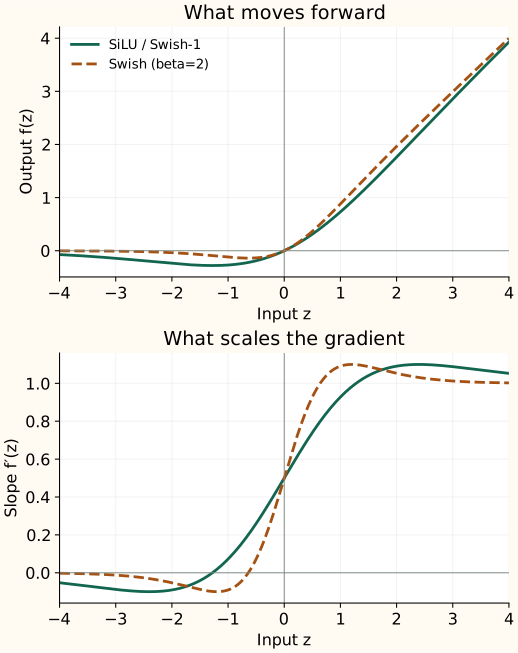
For a large positive input, the sigmoid is close to one, so the input largely passes through. A moderately negative input receives a smaller positive weight and remains negative. Very negative inputs approach zero from below.
SiLU means sigmoid linear unit. Swish describes the family with an extra scale $\beta$:
SiLU is Swish with $\beta=1$. For $\beta\geq0$, increasing $\beta$ sharpens the transition. At $\beta=0$ the function is $z/2$; as $\beta$ grows without bound, the outputs approach ReLU. The Swish paper studies this family, including fixed and learned choices.
The sigmoid weight also changes
Use the product rule on $z\,\sigma(\beta z)$. Differentiating the input gives the sigmoid term. Differentiating the sigmoid contributes its derivative and a factor $\beta$ from the chain rule:
For SiLU, set $\beta=1$. Keeping only $\sigma(z)$ would miss the change in the weight. The full derivative can be negative in part of the negative region and slightly exceed one elsewhere.
| Function | −1 | 0 | 1 |
|---|---|---|---|
| SiLU / Swish-1 | -0.2689 | 0.0000 | 0.7311 |
| Swish (beta=2) | -0.1192 | 0.0000 | 0.8808 |
Advantages and disadvantages
| Function | Advantages | Disadvantages |
|---|---|---|
| SiLU | Smooth self-gating retains moderate negative inputs and approaches the identity on the positive side, without an extra shape parameter. | Needs a sigmoid and multiplication. Its negative tail still has small gradients, and the non-monotonic dip means slopes need not stay between zero and one. |
| Swish | For $\beta>0$, offers the same smooth behavior with control over transition sharpness. The shape can be fixed or learned. | Adds a setting or learned parameter. At $\beta=0$ it is linear, so it supplies no nonlinearity; for positive $\beta$, negative-tail gradients still become small. |
Check computation as well as shape
Use a numerically stable sigmoid primitive. SiLU and Swish need a sigmoid and multiplication, with an extra scaling multiply when $\beta\neq1$. Actual speed depends on available fused kernels, precision, tensor sizes, and hardware, so operation counts alone are not a timing result.
Both are hidden-feature transformations. Their outputs are not probabilities and need not lie between zero and one. A smooth non-monotonic curve is a design choice to test, not a guarantee of better accuracy.
Next, SwiGLU uses SiLU on one learned branch to modulate a separate learned branch.